Observations
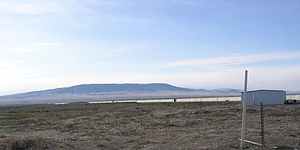
Based on current models of astronomical events, and the predictions of the general theory of relativity, gravitational waves that originate tens of millions of light years from Earth are expected to distort the 4-kilometre (2.5 mi) mirror spacing by about 10−18 m, less than one-thousandth the charge diameter of a proton. Equivalently, this is a relative change in distance of approximately one part in 1021. A typical event which might cause a detection event would be the late stage inspiral and merger of two 10-solar-mass black holes, not necessarily located in the Milky Way galaxy, which is expected to result in a very specific sequence of signals often summarized by the slogan chirp, burst, quasi-normal mode ringing, exponential decay.
In their fourth Science Run at the end of 2004, the LIGO detectors demonstrated sensitivities in measuring these displacements to within a factor of 2 of their design.
During LIGO's fifth Science Run in November 2005, sensitivity reached the primary design specification of a detectable strain of one part in 1021 over a 100 Hz bandwidth. The baseline inspiral of two roughly solar-mass neutron stars is typically expected to be observable if it occurs within about 8 million parsecs (26×106 ly), or the vicinity of the Local Group, averaged over all directions and polarizations. Also at this time, LIGO and GEO 600 (the German-UK interferometric detector) began a joint science run, during which they collected data for several months. Virgo (the French-Italian interferometric detector) joined in May 2007. The fifth science run ended in 2007, after extensive analysis of data from this run did not uncover any unambiguous detection events.
In February 2007, GRB 070201, a short gamma-ray burst arrived at Earth from the direction of the Andromeda Galaxy. The prevailing explanation of most short gamma-ray bursts is the merger of a neutron star with either a neutron star or a black hole. LIGO reported a non-detection for GRB 070201, ruling out a merger at the distance of Andromeda with high confidence. Such a constraint was predicated on LIGO eventually demonstrating a direct detection of gravitational waves.
Enhanced LIGOedit
After the completion of Science Run 5, initial LIGO was upgraded with certain technologies, planned for Advanced LIGO but available and able to be retrofitted to initial LIGO, which resulted in an improved-performance configuration dubbed Enhanced LIGO. Some of the improvements in Enhanced LIGO included:
- Increased laser power
- Homodyne detection
- Output mode cleaner
- In-vacuum readout hardware
Science Run 6 (S6) began in July 2009 with the enhanced configurations on the 4 km detectors. It concluded in October 2010, and the disassembly of the original detectors began.
Advanced LIGOedit
After 2010, LIGO went offline for several years for a major upgrade, installing the new Advanced LIGO detectors in the LIGO Observatory infrastructures.
The project continued to attract new members, with the Australian National University and University of Adelaide contributing to Advanced LIGO, and by the time the LIGO Laboratory started the first observing run 'O1' with the Advanced LIGO detectors in September 2015, the LIGO Scientific Collaboration included more than 900 scientists worldwide.
The first observing run operated at a sensitivity roughly 3 times greater than Initial LIGO, and a much greater sensitivity for larger systems with their peak radiation at lower audio frequencies.
On 11 February 2016, the LIGO and Virgo collaborations announced the first observation of gravitational waves. The signal was named GW150914. The waveform showed up on 14 September 2015, within just two days of when the Advanced LIGO detectors started collecting data after their upgrade. It matched the predictions of general relativity for the inward spiral and merger of a pair of black holes and subsequent ringdown of the resulting single black hole. The observations demonstrated the existence of binary stellar-mass black hole systems and the first observation of a binary black hole merger.
On 15 June 2016, LIGO announced the detection of a second gravitational wave event, recorded on 26 December 2015, at 3:38 UTC. Analysis of the observed signal indicated that the event was caused by the merger of two black holes with masses of 14.2 and 7.5 solar masses, at a distance of 1.4 billion light years. The signal was named GW151226.
The second observing run (O2) ran from 30 November 2016 to 25 August 2017, with Livingston achieving 15–25% sensitivity improvement over O1, and with Hanford's sensitivity similar to O1. In this period, LIGO saw several further gravitational wave events: GW170104 in January; GW170608 in June; and five others between July and August 2017. Several of these were also detected by the Virgo Collaboration. Unlike the black hole mergers which are only detectable gravitationally, GW170817 came from the collision of two neutron stars and was also detected electromagnetically by gamma ray satellites and optical telescopes.
The third run (O3) began on 1 April 2019 and is planned to last until 30 April 2020. Future observing runs will be interleaved with commissioning efforts to further improve the sensitivity. It is aimed to achieve design sensitivity in 2021.
On 6 January 2020, LIGO announced the detection of what appeared to be gravitational ripples from a collision of two neutron stars, recorded on 25 April 2019, by the LIGO Livingston detector. Unlike GW170817, this event did not result in any light being detected. Furthermore, this is the first published event for a single-observatory detection, given that the LIGO Hanford detector was temporarily offline at the time and the event was too faint to be visible in Virgo's data.


Comments
Post a Comment